






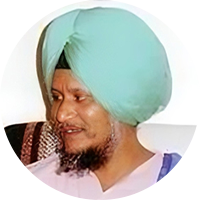


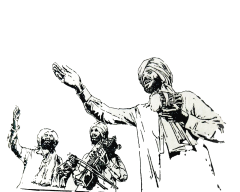

Sant Ram Udasi was one of the prominent revolutionary and people’s poets of Punjabi literature, who, during the late 1960s, voiced the concerns of Dalit and working-class consciousness in the backdrop of the Naxalbari movement. Through his poetry, he consistently raised his voice against caste hierarchies, capitalism, and social inequalities. He was born on April 20, 1939, in the village of Raeser, District Barnala, to parents Mehr Singh and Dhan Kaur. After completing his matriculation, he pursued the JBT course and later joined as a primary school teacher in the village of Beehle.
The life of Sant Ram Udasi was marked by struggle and resilience. His poetic journey was deeply rooted in the lived realities of the exploited working classes, and his verses strongly opposed capitalist exploitation and feudal oppression. Though influenced at different stages by the Kuka movement, romantic idealism, and progressive thought, his ultimate ideological allegiance remained with Naxalite revolutionary politics, which continued to shape his creativity. His poetry, therefore, became an instrument of awakening, reflecting the uncompromising zeal of the Naxalbari-inspired resistance.
Among his significant works are Lahoo Bhije Bol, Plethi Udaan, Saentaan, Chonukkrian Seekhan, and iconic songs such as “Maan Dhartiye Teri God Nu” and “Udd Ja Kawan Kaliya”. On August 13, 1971, he rose to prominence as a major poet during a celebrated Kavi Darbar in Nakodar. In 1985, his stature was recognized when he was weighed against coins at Punjabi Bhavan, Ludhiana, and honored with the prestigious Bawa Balwant Award.
Sant Ram Udasi’s life came to an untimely end on November 6, 1986, while traveling by train near Hazur Sahib, Nanded. In his will, he left behind a message of enduring commitment to his ideology: “Do not weep at my death, but safeguard my thought.” His admirers fondly remember him as “the sun of the workers’ courtyard.” To honor his memory, a school, bus stand, and stadium in his native Raeser have been named after him. Furthermore, the Lok Kavi Sant Ram Udasi Memorial Trust continues to preserve and carry forward his literary and ideological legacy.