








Professor Puran Singh
 1881
– 1931
1881
– 1931


A distinctive poet, thinker, prose writer, translator, and a scientist in the field of chemical engineering.
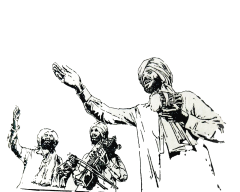

Professor Puran Singh is a distinguished and influential name in Punjabi literature. He is considered one of the pioneers of modern Punjabi poetry, enriching the Punjabi language with a new consciousness and an open style. Beyond his role as a poet, he also made multifaceted contributions as a scientist, translator, thinker, and chemical engineer. His works uniquely blend Western literary consciousness, Oriental mysticism, and religious fervor, giving Punjabi literature a fresh hue.
Puran Singh was born on February 17, 1881, in the village of Salhad, Abbottabad district, now in Pakistan. His father, Kartar Singh, was an officer in the Excise Department, and his mother was Parma Devi. From childhood, he exhibited a deep affinity for mysticism and nature.
In 1897, he completed his matriculation from Rawalpindi High School. For further studies, he enrolled in D.A.V. College. During his B.A. studies, he received a scholarship from Bhai Golak Chand and went to Japan for higher education. There, he conducted specialized research in chemistry and industrial chemistry. While in Japan, he was drawn to Buddhism and embraced the life of a monk.
Upon returning to India, he settled in Calcutta and played a significant role in the Indian freedom struggle by collaborating with revolutionaries. His anti-British activities led to his arrest, though he was soon released. In 1913, he met Bhai Vir Singh, whose personality profoundly influenced him, leading him to embrace the philosophy of Gurmat. He wrote in both English and Punjabi.
Puran Singh revolutionized Punjabi poetry by introducing a free-form style, breaking away from traditional metrical structures, which was a groundbreaking development in Punjabi literature. His poetry is imbued with themes of nature, love, mysticism, and humanity. Notable works include poetry collections like *Khulle Maidan*, *Khulle Ghund*, and *Khulle Asmani Rang*, as well as an essay collection titled *Khulle Lekh*. He also authored novels and translated works. Additionally, he wrote around ten books in English.
Puran Singh is often called the "poet of humanity" for his portrayal of love as a natural and uninhibited process, akin to a river merging into the ocean, free of duality. His free-spirited writing and open style gave Punjabi literature a new dimension, continuing to inspire readers today.
In 1930, he contracted tuberculosis (TB), which severely deteriorated his health. On March 31, 1931, he passed away in Dehradun.
Puran Singh was born on February 17, 1881, in the village of Salhad, Abbottabad district, now in Pakistan. His father, Kartar Singh, was an officer in the Excise Department, and his mother was Parma Devi. From childhood, he exhibited a deep affinity for mysticism and nature.
In 1897, he completed his matriculation from Rawalpindi High School. For further studies, he enrolled in D.A.V. College. During his B.A. studies, he received a scholarship from Bhai Golak Chand and went to Japan for higher education. There, he conducted specialized research in chemistry and industrial chemistry. While in Japan, he was drawn to Buddhism and embraced the life of a monk.
Upon returning to India, he settled in Calcutta and played a significant role in the Indian freedom struggle by collaborating with revolutionaries. His anti-British activities led to his arrest, though he was soon released. In 1913, he met Bhai Vir Singh, whose personality profoundly influenced him, leading him to embrace the philosophy of Gurmat. He wrote in both English and Punjabi.
Puran Singh revolutionized Punjabi poetry by introducing a free-form style, breaking away from traditional metrical structures, which was a groundbreaking development in Punjabi literature. His poetry is imbued with themes of nature, love, mysticism, and humanity. Notable works include poetry collections like *Khulle Maidan*, *Khulle Ghund*, and *Khulle Asmani Rang*, as well as an essay collection titled *Khulle Lekh*. He also authored novels and translated works. Additionally, he wrote around ten books in English.
Puran Singh is often called the "poet of humanity" for his portrayal of love as a natural and uninhibited process, akin to a river merging into the ocean, free of duality. His free-spirited writing and open style gave Punjabi literature a new dimension, continuing to inspire readers today.
In 1930, he contracted tuberculosis (TB), which severely deteriorated his health. On March 31, 1931, he passed away in Dehradun.